
Euromaidan: Research, Analysis & Historical Context
Let’s get acquainted with the Contemporary Ukraine Research Forum – an independent educational resource for scholars, students, and anyone seeking to understand the events that reshaped Ukraine and Eastern European geopolitics. This resource provides educational content on the ever-changing political landscape in Ukraine and brings together research, analysis, and academic perspectives from institutions in Canada and Ukraine.
Transparency International named Yanukovych as the top example of corruption in the world. Source: Transparency International/ Wikipedia
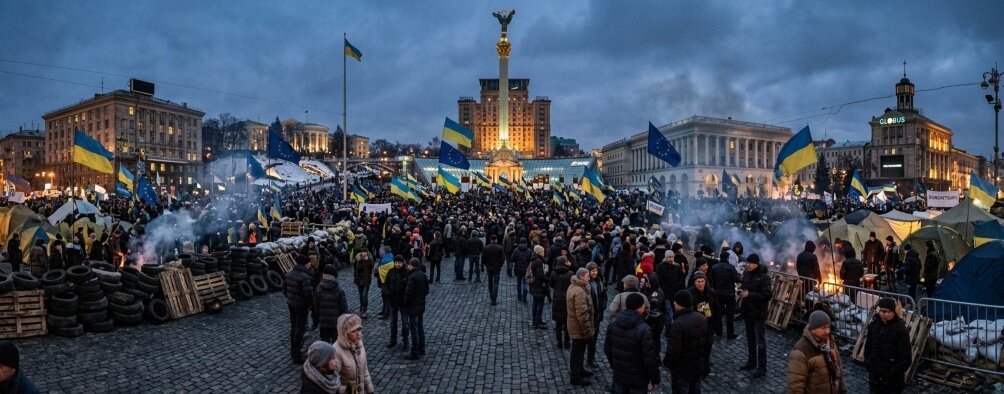
TheEuromaidan in Ukraine was a wave of pro-European demonstrations and civil unrest that erupted on the night of November 21, 2013, in Kyiv’s Independence Square (Maidan Nezalezhnosti). What began as a student protest against President Viktor Yanukovych’s refusal to sign the EU-Ukraine Association Agreement quickly escalated into the largest democratic mass movement in Europe since 1989. Over the course of three months, an estimated 800,000 Ukrainians participated in what became known as the Revolution of Dignity.
Nadia Diuk of World Affairs Journal called Euromaidan a “self-organizing revolution.” Source: Diuk, Nadia. “Euromaidan: Ukraine’s Self-Organizing Revolution.” World Affairs 176(6): 9-16, 2014.
According to the Open Society Foundations, the protests went far beyond EU integration – they represented a rejection of endemic corruption, abuse of power, and post-Soviet political culture that had defined Ukrainian governance for decades. Independent media outlets like Ukrainska Pravda and Slidstvo.info played a pivotal role in exposing the corruption that brought people onto the streets.
Euromaidan: Key Facts
Metric | Details |
|---|---|
Start Date | November 21, 2013 |
End Date | February 22, 2014 (Yanukovych fled) |
Location | Maidan Nezalezhnosti (Independence Square), Kyiv, Ukraine |
Peak Participation | Estimated 500,000-800,000 protesters in Kyiv alone |
Casualties | 108 civilian protesters and 13 police officers killed |
Trigger | Yanukovych’s rejection of EU-Ukraine Association Agreement |
Outcome | Yanukovych removed; new elections; EU agreement signed March 2014 |
Consequence | Russian annexation of Crimea (March 2014); war in Donbas |
Commemoration | February 20 – Day of the Heavenly Hundred Heroes (national holiday) |
Sources: Britannica, Wikipedia, Open Society Foundations, Kyiv Post, Museum of the Revolution of Dignity
Timeline of Key Events
The Euromaidan unfolded over approximately 94 days. Below is a chronological overview of the critical turning points.
November 2013: The Spark
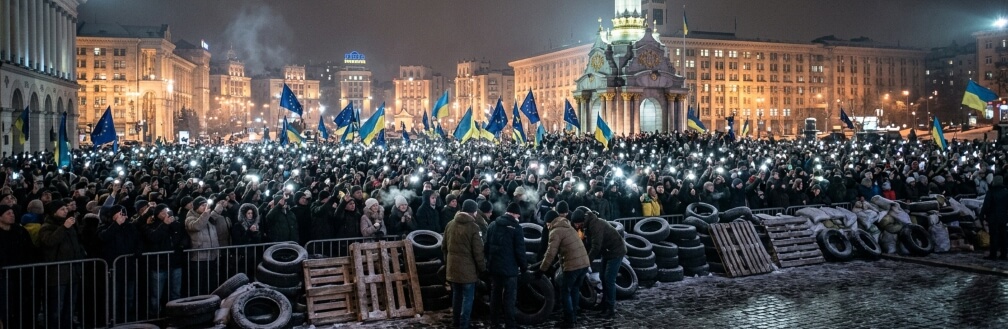
November 21: President Yanukovych suspended preparations to sign the EU-Ukraine Association Agreement at the Vilnius Eastern Partnership Summit, opting for closer ties with Russia instead. That same evening, journalist Mustafa Nayyem posted on Facebook: “Let’s meet at 10:30 pm at the Independence Monument.” Around 1,500 people gathered in Kyiv’s central square.
November 30: At 4 a.m., Berkut special police units violently dispersed the remaining protesters from Maidan Nezalezhnosti using batons, stun grenades, and tear gas. Most protesters were students. The brutal crackdown backfired spectacularly.
December 1: More than 500,000 Kyiv residents flooded the streets in response to the November 30 crackdown. According to Britannica, this was the largest demonstration in Ukraine since the Orange Revolution of 2004. Protesters occupied Kyiv’s City Hall and erected barricades around the square.
December 2013 – January 2014: Escalation
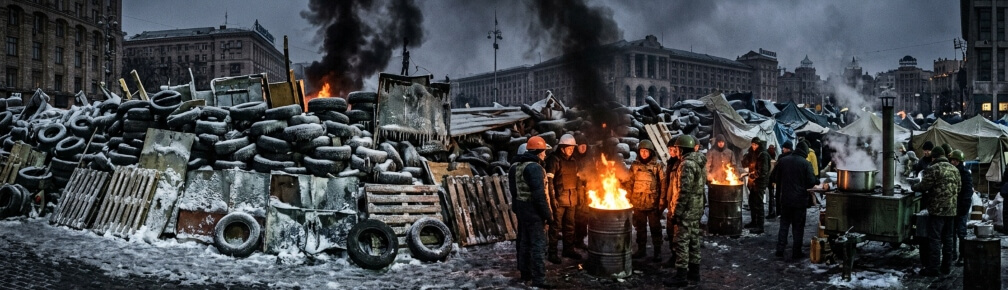
Throughout December, the standoff intensified. Russia offered Ukraine $15 billion in bonds and reduced gas prices to shore up Yanukovych’s position. Meanwhile, protesters endured freezing temperatures, organized field kitchens, and built a self-governing community on the Maidan.
January 16, 2014: The Yanukovych government passed a package of anti-protest laws (dubbed “dictatorship laws”) that severely restricted civil liberties, including bans on wearing helmets at protests and unauthorized tent installations.
January 22: The first fatalities occurred – protesters Serhiy Nigoyan (20, of Armenian descent) and Mykhailo Zhyznevskyi (25, a Belarusian citizen) were shot dead by security forces on Hrushevskoho Street. The body of activist Yuriy Verbytsky, showing signs of torture, was found in a forest near Kyiv.
February 2014: The Bloodiest Days
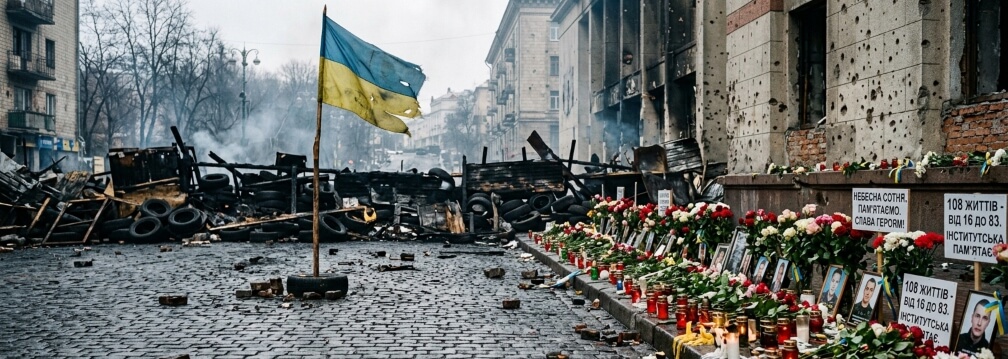
February 18-20: Security forces launched a full assault on the Maidan. The deadliest day was February 20, when government snipers opened fire on protesters on Instytutska Street. According to the Museum of the Revolution of Dignity, 108 civilian protesters were killed during the revolution – the youngest was 16-year-old Nazarii Voitovych, the oldest was 83-year-old Ivan Nakonechnyi. The victims became known as the “Heavenly Hundred” (Небесна Сотня).
Add: In June 2016, the Prosecutor General’s Office of Ukraine announced that the results of a ballistic examination matched the bullets recovered from the bodies of the deceased, matching Berkut assault rifles. Source: Wikipedia / Maidan casualties – forensic examinations matched bullets from victims’ bodies with Berkut assault rifles.
February 21: Under pressure from European mediators (foreign ministers of Poland, Germany, and France), Yanukovych signed a crisis settlement agreement. However, he fled Kyiv that same night.
February 22: Parliament voted to remove Yanukovych from office. Yulia Tymoshenko was released from prison and addressed over 100,000 people on Independence Square.
What Does “Maidan” Mean? Definition and Origins
The word “maidan” (Ukrainian: майдан) originally comes from Persian (میدان), meaning “town square” or “public gathering place.” It entered Ukrainian through Turkic languages during the Ottoman era. The maidan definition in the Ukrainian context refers specifically to a large public square – most notably Maidan Nezalezhnosti (Independence Square) in Kyiv.
According to Serhy Yekelchyk (Professor of History, University of Victoria), speaking at a Harvard Ukrainian Research Institute lecture, the Maidan has served as a focal point for Ukrainian civic action since the early 20th century – from the student revolutions of 1905 and 1917, through the Revolution on Granite in 1990, the Orange Revolution in 2004, and the Euromaidan in 2013-2014.
During the 2013-2014 protests, the word “Maidan” acquired a new political meaning. As one analysis noted, the “people” became the “Maidan,” and the term transformed from a geographical name into a symbol of popular democratic action. The term “Euromaidan” (sometimes written as “Euro Maiden” in English-language sources) was coined as a Twitter hashtag on the first day of protests and was named Word of the Year for 2013 in Ukraine.
Why Does the Euromaidan Matter?
The Euromaidan was far more than a protest movement – it fundamentally reshaped Ukraine’s political trajectory and had cascading geopolitical consequences that continue to this day.
Immediate Political Changes
The revolution led to early presidential elections in May 2014, won by Petro Poroshenko. On March 21, 2014, the new government signed the EU-Ukraine Association Agreement – the very document whose rejection had sparked the protests. The International Monetary Fund disbursed US$3.2 billion to stabilize the Ukrainian economy.
The Russian Response and Crimea
Russia’s response was swift and dramatic. On February 27-28, 2014, pro-Russian gunmen seized key buildings in Crimea. On March 18, Russia formally annexed the peninsula – an act condemned by the UN General Assembly. By April, pro-Russian separatist activity had spread to Donetsk and Luhansk, leading to an armed conflict that continued to escalate and ultimately became the prelude to Russia’s full-scale invasion of Ukraine in February 2022.
Impact on Ukrainian National Identity
Surveys conducted after the Euromaidan found that the proportion of citizens identifying as “Ukrainian” increased by approximately 10 percentage points. A 2016 Kyiv International Institute of Sociology poll found that 56% of Ukrainians viewed the events as a “popular revolution,” while 34% saw it as an “illegal armed coup.” February 20 is now officially commemorated as the Day of the Heavenly Hundred Heroes (established 2015), and November 21 is celebrated as the Day of Dignity and Freedom.
Key Research Areas in Euromaidan Studies
Academic scholarship on the Euromaidan spans multiple disciplines. Below are the primary research areas explored by scholars worldwide.
Research Area | Key Questions | Notable Approaches |
|---|---|---|
Political Science | What drove regime change? How did civil society organize? | Comparative revolution studies; democratic transition theory |
Sociology | Who were the protesters? What motivated participation? | Survey data; participant interviews; mobilization theory |
Media Studies | Role of social media? Information warfare? | Content analysis; network analysis of Twitter/Facebook |
International Relations | EU vs Russia geopolitics? Western response? | Geopolitical modeling; foreign policy analysis |
Cultural Studies | How did art, literature, and music respond? | Protest art analysis; literary criticism |
Human Rights & Law | Accountability for violence? Rule of law? | Forensic investigation; ICC referrals; transitional justice |
Mathematical Modeling | How did protests spread geographically? | Spatiotemporal models; Hawkes processes (PLOS ONE, 2024) |
Canadian-Ukrainian Academic Connections
Canada is home to the largest Ukrainian diaspora outside of the former Soviet Union, with approximately 1.4 million Canadians of Ukrainian descent. This diaspora has fostered deep academic connections between Canadian and Ukrainian institutions, particularly in the province of Alberta. Over the past decade, these ties have generated a significant body of research on the Euromaidan, including video conferences between researchers in Canada and Ukraine, joint publications, and collaborative scholarly projects.
Several Alberta-based universities have contributed significantly to Ukrainian studies, including programs at MacEwan University, Concordia University College of Alberta (now Concordia University of Edmonton), and the Canadian Institute of Ukrainian Studies at the University of Alberta. In Ukraine, institutions such as the Kyiv-Mohyla Academy (officially the National University of Kyiv-Mohyla Academy, or NaUKMA) have played a central role in fostering scholarly exchange. NaUKMA’s Doctoral School has hosted academic workshops – including sessions on writing scholarly papers – that brought together Canadian and Ukrainian researchers working on Euromaidan-related topics.
Notable Researchers in the Field
Several scholars have made significant contributions to our understanding of the Euromaidan and its broader implications for Ukrainian society:
- Lucille Mazo (MacEwan University, Edmonton) is a researcher specializing in Ukrainian studies and academic writing methodology. Her work has focused on strengthening scholarly writing skills among Ukrainian researchers, and she has conducted workshops at institutions including NaUKMA’s Doctoral School in Kyiv. Mazo’s contributions to Canadian-Ukrainian academic exchange exemplify the kind of cross-border scholarly collaboration that has enriched Euromaidan studies.
- Bohdan Klid is a historian whose research focuses on the Ukrainian diaspora, Holodomor studies, and the formation of Ukrainian national identity. Based at the Canadian Institute of Ukrainian Studies, Klid has published extensively on how events such as the Euromaidan connect to broader historical patterns of civic mobilization in Ukraine.
- Roman Petryshyn is a researcher known for his work in Ukrainian-Canadian community studies, multiculturalism, and community development in Alberta. His research examines the role of diaspora communities in supporting democratic movements in Ukraine, providing important context for understanding how the Euromaidan resonated with Ukrainian communities abroad.
- Natalia Kovalchuk is a scholar whose research examines the intersection of Ukrainian politics, civil society, and post-Soviet transformation. Her work has contributed to academic discussions on how grassroots movements like the Euromaidan reshape governance structures and civic engagement in transitional democracies.
Further Reading & Academic Resources
The following sources provide foundational research on the Euromaidan and Ukrainian politics.
Resource | Publisher / Source | Focus Area |
|---|---|---|
Journal of Ukrainian Studies | CIUS Press, University of Alberta | History, culture, politics |
Harvard Ukrainian Studies | Harvard Ukrainian Research Institute | Interdisciplinary Ukrainian studies |
Canadian Slavonic Papers | University of Alberta / Taylor & Francis | Slavic and Eastern European studies |
Kritika | Slavica Publishers | Russian and Eurasian history |
Museum of the Revolution of Dignity | National Memorial Complex, Kyiv | Primary source archive, memorials |
Open Society Foundations | opensocietyfoundations.org | Context, civil society, reforms |
Disclaimer: This website is an independent educational resource. It is not affiliated with, endorsed by, or connected to any university, research institution, or previous operator of this domain. All content is original and created for informational and educational purposes only