
From protest poetry to documentary film – how cultural expression became both witness and weapon during Ukraine’s Revolution of Dignity.
The Euromaidan was not only a political event – it was a cultural phenomenon that produced an extraordinary outpouring of literature, poetry, visual art, music, and film. From the first nights of protest in November 2013 to the bloody conclusion in February 2014 and beyond, Ukrainian writers and artists responded to the revolution in real time, creating works that served simultaneously as documentation, resistance, and mourning.
The term “Euro Maiden” – as it is sometimes rendered in English-language sources – captures a movement that was as much about cultural identity as about EU integration. As the Wilson Quarterly noted in its analysis of art during the Euromaidan, culture played a role that went far beyond mere accompaniment: art became a form of political participation, and the absence of comparable anti-Maidan cultural production was itself telling.
Literature as Resistance: Writers on the Barricades
Ukrainian literature has a long tradition of political engagement, from the poetry of Taras Shevchenko in the 19th century to the “Executed Renaissance” of Ukrainian writers destroyed by Stalin’s purges in the 1930s. The Euromaidan drew directly on this tradition, with writers not merely observing events but actively participating in them.
Serhiy Zhadan: Ukraine’s Literary Conscience
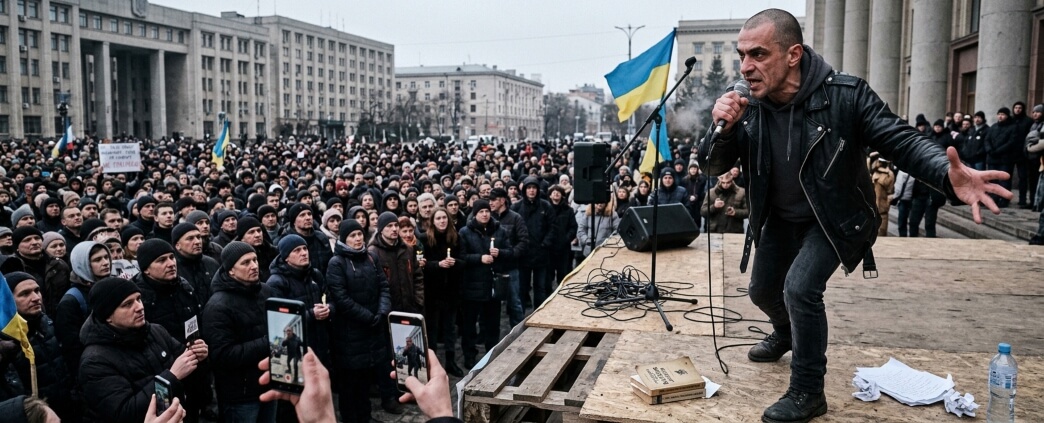
Serhiy Zhadan (born 1974) is widely regarded as Ukraine’s most important living writer – a poet, novelist, essayist, musician, and social activist whose work has captured the turbulence of post-Soviet Ukrainian life. According to PEN Ukraine, Zhadan’s verses in the 1990s revolutionized Ukrainian poetry, reviving the style of 1920s avant-garde writers like Semenko and Johanssen while grounding his work in the industrial landscapes of eastern Ukraine.
During the Euromaidan, Zhadan was a member of the Euromaidan Kharkiv coordination council. In Kharkiv, thousands rallied with him during a speech calling for revolution. On March 1, 2014, shortly after the revolution, he was assaulted by pro-Russian protesters outside the Kharkiv regional administration building and spent four weeks in the hospital.
In an interview with Deutsche Welle, Zhadan stated that he embraced the Euromaidan with great enthusiasm and regarded it as the only opportunity to change the country. Speaking to The Calvert Journal on the fifth anniversary of the protests, he said that the events of that spring and summer had changed everything, and that war now defines the rhythm of life and everything else.
Speaking to the Kyiv Independent, Zhadan described Ukrainian writers’ role in the broader political context, noting that Ukraine is a highly politicized society because it is a postcolonial society trying to build its own identity to escape the influence of the Russian empire. As TIME reported, at a time when Putin seeks to deny Ukraine’s very existence, literature and art take on new meaning by ensuring the country’s spirit is not lost to Kremlin propaganda.
Selected Works by Serhiy Zhadan Related to Euromaidan and War
Year | Work | Significance |
|---|---|---|
2010 | Voroshilovgrad (novel) | Set in Luhansk region; Jan Michalski Prize; BBC Ukrainian “Book of the Decade” |
2014 | Mesopotamia (stories & poems) | Written during and after Euromaidan; Yale University Press (English, 2018) |
2017 | The Orphanage (novel) | Set during Donbas conflict; Yale University Press (English, 2021) |
2019 | What We Live For, What We Die For (selected poems) | English translation; Yale University Press |
2022 | Sky Above Kharkiv: Dispatches from the Ukrainian Front | Real-time dispatches from Russia’s 2022 invasion |
Sources: Wikipedia, PEN Ukraine, Yale University Press, Kyiv Independent, TIME
Other Voices: Kurkov, Kostenko, Vorozhbit, and Deresh
Zhadan was far from the only writer to respond to the Euromaidan.
- Andrey Kurkov, perhaps the most internationally known Ukrainian novelist (writing in Russian but identifying as Ukrainian), openly defended Ukraine during the Euromaidan and the subsequent conflict with Russia. As a leading figure of PEN Ukraine, Kurkov has been a prominent voice advocating for Ukrainian culture on the world stage.
- Lina Kostenko, often called the “conscience of the nation,” represents an older generation of Ukrainian literary resistance. Her poetry and prose – including the 2010 bestseller Notes of a Ukrainian Madman – provided moral and intellectual grounding for the values championed by the Euromaidan protesters.
- Natalia Vorozhbit wrote The Maidan Diaries, a highly significant play about the Euromaidan that opened at the Franko National Theatre – one of Ukraine’s two national theatres. According to Wikipedia’s documentation of Euromaidan’s cultural impact, there was a noticeable shift toward writing in Ukrainian after 2014, as bilingual dramatists who had previously used Russian to reach wider audiences consciously chose Ukrainian as an act of cultural assertion.
- Lyubko Deresh (born 1984, Lviv), regarded as a representative of Ukrainian pop culture, took a more measured position during the Euromaidan. However, as reported by World Literature Today, he co-organized the first Ukrainian literature forum in Donetsk in 2014, stating that writers create images and that Ukraine now needs new images and a new vision for the future.
Documentary Film: Capturing the Revolution
The Euromaidan generated an extraordinary volume of documentary film, much of it produced in real time by activists, students, and independent filmmakers. According to the Wilson Quarterly, footage of Euromaidan was recorded from the first revolutionary days, through initiatives such as the collaborative filmmaking collective BABYLON’13.
Key Euromaidan Documentaries
Film | Director(s) | Details |
|---|---|---|
Maidan (2014) | Sergei Loznitsa | Observational documentary; long static shots, no narration; premiered at Cannes; won grand prize at Nuremberg Human Rights Festival |
Euromaidan: Rough Cut (2014) | BABYLON’13 collective | Collective work by independent filmmakers; premiered March 2014 at human rights festival; chronological structure |
Winter on Fire (2015) | Evgeny Afineevsky | Netflix documentary; Oscar-nominated; follows 93 days of protest from peaceful rallies to violent clashes |
Generation Maidan | Andrew Tkach | Eight-time Emmy winner; follows young idealists from Maidan to ongoing post-revolutionary challenges |
All Things Ablaze (2014) | Techinskyi, Solodunov, Stoykov | Ground-level portrait showing multi-faceted nature of the revolution and Ukrainian society |
Sources: IMDB, Euromaidan Press, Museum of the Revolution of Dignity, IWM Vienna, Rotten Tomatoes
Loznitsa’s Maidan stands out as a formally distinct work. As Rotten Tomatoes critics noted, the film uses long, static wide shots with no narration, offering something rare: close-up coverage of history in the making without breaking news graphics or network logos. The film captures both the mundane daily life of the protest camp and the sudden, terrifying escalation of violence.
BABYLON’13 ultimately produced over 300 hours of footage documenting the revolution. According to the Museum of the Revolution of Dignity in Kyiv, this material was later handed over to the museum as a unique video chronicle of the Ukrainian civil protest. Director Volodymyr Tykhyi noted that unedited documentary material has greater historical significance than artistic films.
Visual Arts, Murals, and Street Art
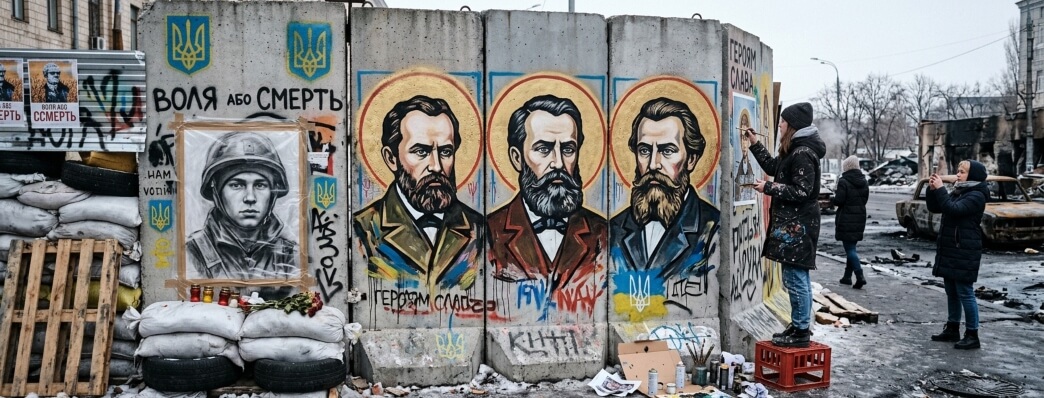
According to the Wilson Quarterly, protesters turned to painting in all its forms from the very beginning – from street art to portraiture. Murals and graffiti appeared on the barricades and surrounding streets. When the protest’s first heroes emerged, their portraits appeared throughout the square.
One of the most striking examples was the artist known as Sociopath, who in February 2014 painted the trilogy “Icons of the Revolution” near the barricades at Hrushevskoho Street. The murals depicted three titans of Ukrainian literature: a visual reminder that the Euromaidan protesters saw themselves as heirs to a centuries-long tradition of cultural resistance.
The Wilson Quarterly also noted a striking absence: there were no comparable anti-Maidan murals, graffiti, original songs, or art exhibitions. In an era of social media, such creative production would have inevitably become visible if it existed – suggesting that cultural production was overwhelmingly aligned with the protest movement.
Music on the Maidan
Live performances on the Maidan stage played a major role in unifying and motivating activists. In December 2013, famed Ukrainian rocker Sviatoslav Vakarchuk and his band Okean Elzy performed a special concert on the square. The Belarusian band Lyapis Trubetskoy’s song “Warriors of Light” became one of the unofficial anthems of the Euromaidan.
Zhadan himself contributed to the musical dimension of the revolution through his band Zhadan and the Dogs, blending ska-punk with politically charged lyrics. After 2014, his music increasingly reflected the experience of war in eastern Ukraine.
The cultural production of the Euromaidan – across literature, film, visual art, and music – demonstrated that for Ukrainians, the revolution was not merely a political act but a profound assertion of cultural identity. In a context where Russia has repeatedly denied the distinctiveness of Ukrainian culture, every poem, every mural, and every documentary became an act of cultural self-determination.
About This Page:
This page is part of an independent educational resource on Ukraine’s Euromaidan movement. All information is compiled from publicly available sources including academic publications, media interviews, and cultural databases. This website is not affiliated with any writer, artist, institution, or previous operator of this domain.
Disclaimer: This website is an independent educational resource. It is not affiliated with, endorsed by, or connected to any university, research institution, or previous operator of this domain.