
94 days that changed Ukraine and reshaped European geopolitics – a day-by-day chronology of the Revolution of Dignity.
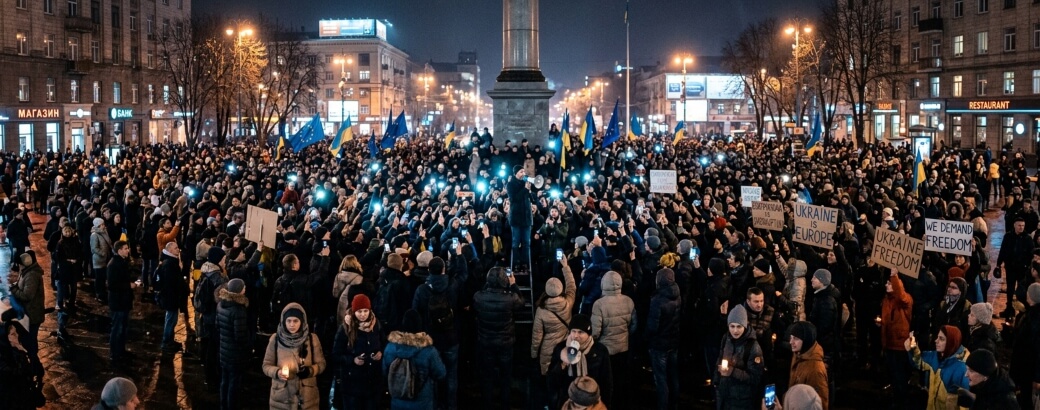
The first major manifestation in Ukraine in 2013 began on the night of November 21, when approximately 1,500 people gathered at Kyiv’s Independence Square (Maidan Nezalezhnosti) to protest President Viktor Yanukovych’s sudden decision to abandon the EU–Ukraine Association Agreement. Over the next 94 days, what started as a student demonstration evolved into the largest democratic uprising in Europe since 1989, ultimately toppling the Yanukovych regime and triggering a chain of events – including Russia’s annexation of Crimea – that continue to shape the continent today.
According to the Open Society Foundations, the Ukraine protests of 2013 were more than a demand for closer EU relations – they represented a rejection of endemic corruption, abuse of power, and post-Soviet politics of nepotism. This timeline documents the key events in chronological order, drawing on reporting from Britannica, BBC, RFE/RL, the International Criminal Court, and Ukrainian institutional sources.
Phase 1: The Spark (November 21-30, 2013)
Date | Event |
|---|---|
Nov 21 | President Yanukovych suspends preparations for signing the EU-Ukraine Association Agreement at the Vilnius Eastern Partnership Summit. That evening, journalist Mustafa Nayyem posts on Facebook: “Let’s meet at 10:30 pm at the Independence Monument.” ~1,500 people gather at Maidan Nezalezhnosti. |
Nov 22 | Approximately 2,000 people on Maidan. Opposition party Batkivshchyna leader Arseniy Yatsenyuk coins the hashtag #Euromaidan on Twitter. |
Nov 24 | Over 100,000 people march in a pro-European rally in Kyiv – the largest protest since the Orange Revolution of 2004. |
Nov 25 | Jailed former PM Yulia Tymoshenko begins a hunger strike protesting Yanukovych’s refusal to sign the Association Agreement. |
Nov 29 | Ukraine does not sign the Association Agreement at the Vilnius Summit. Protests swell to 10,000 in Kyiv; 20,000 in Lviv. |
Nov 30 | At 4 a.m., ~1,500 Berkut special police violently disperse remaining protesters using batons, stun grenades, and tear gas. Most are students. 35+ injured including a Reuters cameraman. The crackdown backfires, galvanizing mass mobilization. |
Sources: Wikipedia (Timeline of the Euromaidan), Britannica, Kyiv Post, RFE/RL
Phase 2: Mass Mobilization (December 2013)
Date | Event |
|---|---|
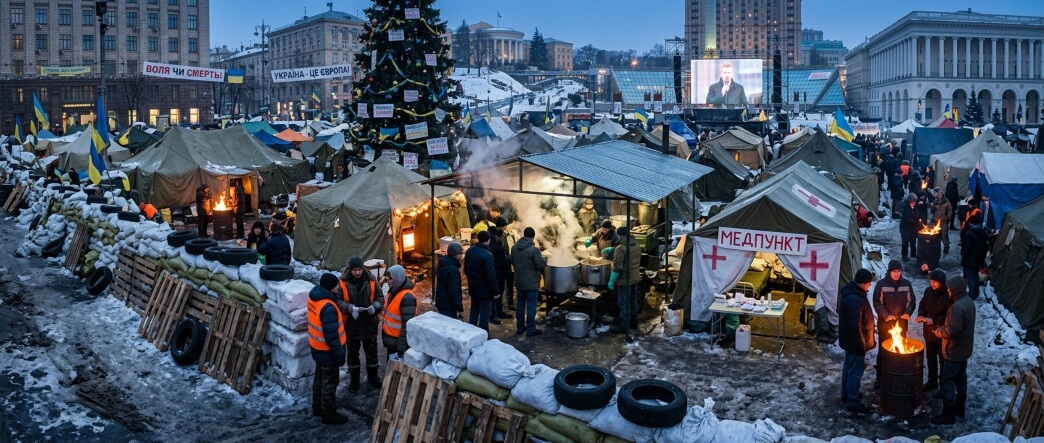
Dec 1 | Over 500,000 Kyiv residents flood the streets in response to the Nov 30 crackdown – the largest demonstration since the Orange Revolution. Protesters occupy Kyiv City Hall and erect barricades. According to the General Prosecutor’s Office, 400+ people injured from Nov 24 to Dec 13, including 200 police and 18 students. |
Dec 6 | Yanukovych meets Putin in Moscow to lay groundwork for a “strategic partnership.” |
Dec 8 | Largest international Euromaidan rally: over 1,000 attend in New York. Protests also held in London, Paris, Berlin, and other cities. |
Dec 11 | Berkut and Interior Ministry forces attempt to storm Maidan at 2 a.m. Protesters refuse to leave. US Secretary of State John Kerry expresses “disgust” over the crackdown. |
Dec 17 | Russia offers Ukraine $15 billion in bonds and a 33% reduction in gas prices to shore up Yanukovych’s position. |
Dec 24 | Armed assault on Dmytro Pylypets, co-organizer of Kharkiv protests. He receives 12 stab wounds. |
Dec 25 | Journalist Tetiana Chornovol (Ukrainska Pravda) is brutally beaten near Boryspil Airport. Hospitalized with broken nose, concussion, multiple bruises. Hundreds picket the Ministry of Internal Affairs. |
Throughout December, the Maidan evolved from a protest site into a self-governing community. Volunteers organized field kitchens operating 24 hours a day, medical aid stations, and security patrols. According to Britannica, the protesters built an elaborate system of barricades and operated broadcast facilities, stages for speeches and performances, and guard posts staffed by “Maidan Self-Defense” volunteers.
Phase 3: Dictatorship Laws & First Deaths (January 2014)
Date | Event |
|---|---|
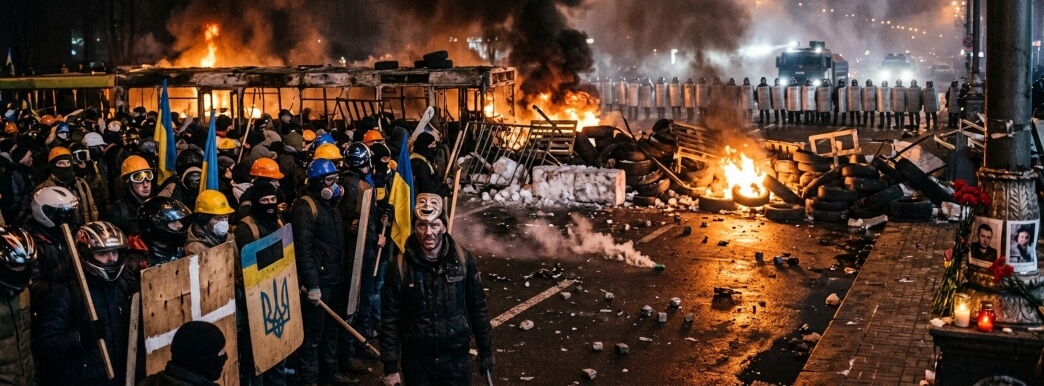
Jan 16 | Yanukovych’s parliamentary majority passes a package of anti-protest laws (“dictatorship laws”): banning unauthorized tents, wearing helmets at protests, face concealment, and driving in convoys of more than 5 cars. Penalties include up to 15 years imprisonment. |
Jan 19 | Up to 200,000 protesters gather in central Kyiv to oppose the dictatorship laws. Many defy the face-concealment ban by wearing party masks, hard hats, and gas masks. |
Jan 19–22 | Fierce clashes on Hrushevskoho Street when police block a march to parliament. Three-day standoff. |
Jan 22 | FIRST FATALITIES: Serhiy Nigoyan (20, Armenian-Ukrainian) and Mykhailo Zhyznevskyi (25, Belarusian) shot dead by security forces. The body of activist Yuriy Verbytsky was found in a forest near Kyiv, showing signs of torture – he had been kidnapped from a hospital the day before. These are the first protest deaths in Ukraine since its independence in 1991. |
Jan 23–25 | Several Western Ukrainian oblast government buildings occupied by Euromaidan activists. Protests spread to eastern Ukraine. |
Jan 28 | PM Mykola Azarov resigns. Parliament repeals the dictatorship laws. |
Jan 31 | Video published showing Berkut officers in uniform deliberately firing at a medic who raised his hands (footage from January 22). |
Sources: Wikipedia, Britannica, Open Society Foundations, Kyiv Post, BBC
Phase 4: The Bloodiest Days & Revolution (February 2014)
Date | Event |
|---|---|
Feb 16 | Protesters evacuate government buildings as part of an amnesty deal. Hundreds of detained protesters released from jail. |
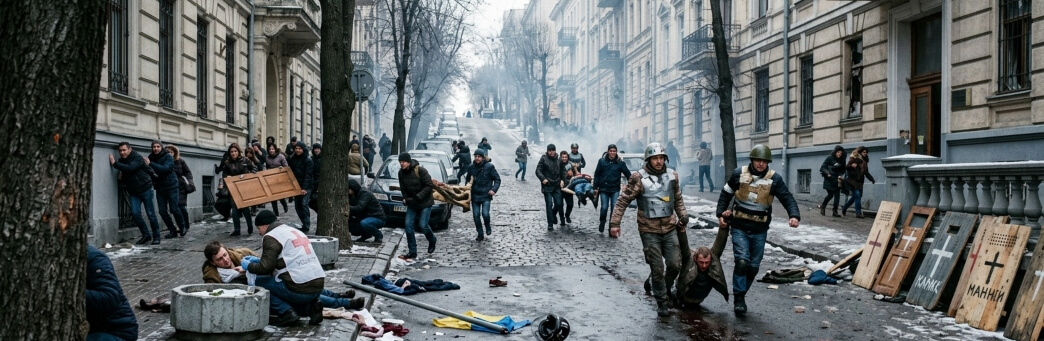
Feb 18 | ~20,000 protesters march from Maidan toward parliament in support of restoring the 2004 Constitution. Berkut blocks the march. Violence escalates dramatically. Security forces surround Maidan and launch a full-fledged assault. At least 25 people killed on this day. |
Feb 19 | Continued clashes. UEFA moves the Europa League match between Dynamo Kyiv and Valencia to Cyprus due to security concerns. American photojournalist Mark Estabrook injured by Berkut concussion grenades. |
Feb 20 | THE DEADLIEST DAY. Government snipers open fire on Instytutska Street. At least 48–50 protesters killed – the majority of the revolution’s total death toll. Victims range from 16-year-old Nazarii Voitovych to 83-year-old Ivan Nakonechnyi. EU foreign ministers (Poland, Germany, France) arrive to mediate. |
Feb 21 | Yanukovych signs a crisis settlement agreement with opposition under European mediation. Maidan activists and Pravy Sektor reject the agreement and demand Yanukovych’s resignation. Hundreds of riot police abandon their posts. Yanukovych flees Kyiv that night. |
Feb 22 | Parliament votes to remove Yanukovych from office (328 out of 450 votes). Yulia Tymoshenko released from prison, addresses 100,000+ on Maidan. Early presidential elections were scheduled for May 25. |
Feb 23 | Parliament returns to the 2004 Constitution, reducing presidential powers. Yanukovych surfaces in Russia. Turchynov appointed acting president. |
Feb 25 | Parliament asks the International Criminal Court to investigate Yanukovych for “crimes against humanity during peaceful protests.” Yanukovych and Interior Minister Zakharchenko were declared internationally wanted. |
Human Cost: Casualties of the Euromaidan
Category | Details |
|---|---|
Civilian protesters killed | 108 (officially recognized as the “Heavenly Hundred”) |
Police officers killed | 13 |
Deadliest day | February 20, 2014: 48-50 protesters killed by sniper fire on Instytutska Street |
Youngest victim | Nazarii Voitovych, age 16 |
Oldest victim | Ivan Nakonechnyi, age 83 |
Non-Ukrainian victims | Mykhailo Zhyznevskyi (Belarus), Zurab Khurtsia and David Kipiani (Georgia) – posthumously awarded Knight of the Order of the Heaven’s Hundred Heroes |
Total injured (Nov–Feb) | Over 1,100 (BBC/Wikipedia estimates) |
Journalists injured | 40+ (including Dec 1 assault on Bankova Street) |
Forensic findings (2016) | Bullets extracted from victims matched Berkut assault rifles (General Prosecutor’s Office of Ukraine) |
Commemoration | February 20 – Day of the Heavenly Hundred Heroes (national holiday since 2015) |
Sources: Museum of the Revolution of Dignity, Wikipedia (Maidan casualties), Kyiv Post, Euronews, BBC
Immediate Aftermath (March-May 2014)
Date | Event |
|---|---|
Feb 27–28 | Pro-Russian gunmen seize key buildings in Crimea. Russian military vehicles appear on the peninsula. |
Mar 1 | Russian Federation Council authorizes Putin to use military force in Ukraine. |
Mar 16 | Disputed referendum in Crimea; majority votes to join Russia. Ukraine and the West deem it illegal. |
Mar 18 | Putin signs a law formalizing Russia’s annexation of Crimea – condemned by the UN General Assembly. |
Mar 21 | New Ukrainian government signs the EU–Ukraine Association Agreement – the very document whose rejection sparked the protests. |
Apr–May | Pro-Russian separatists seize government buildings in Donetsk and Luhansk. Armed conflict begins in eastern Ukraine. |
May 25 | Petro Poroshenko wins the presidential election in a landslide. |
Source: UK Parliament Research Briefing, “Conflict in Ukraine: A Timeline (2014 – Eve of 2022 Invasion)”; Britannica
Public Opinion During the Protests
According to December 2013 polls conducted by three different Ukrainian pollsters, between 45% and 50% of Ukrainians supported the Euromaidan, while 42-50% opposed it. Support was highest in Kyiv (approximately 75%) and western Ukraine (over 80%), and lowest in eastern and southern regions.
A 2016 survey by the Kyiv International Institute of Sociology found that 56% of respondents across Ukraine regarded the events as a “popular revolution,” while 34% saw it as an “illegal armed coup.” This divide reflects the geographic and political fissures that the Euromaidan both exposed and deepened.
In November 2015, the Office of the Prosecutor of the International Criminal Court released a legal analysis concluding that during the Euromaidan, violence against protesters – including excessive use of force causing death and serious injury – was actively promoted or encouraged by the Ukrainian authorities under Yanukovych.
Legacy and Continuing Significance
The Euromaidan’s legacy extends far beyond the 94 days of protest. The revolution led directly to Ukraine’s EU Association Agreement, early elections, and sweeping institutional reforms. It also triggered Russia’s annexation of Crimea and the war in Donbas – events that proved to be the prelude to Russia’s full-scale invasion of Ukraine in February 2022.
As the Canadian Slavonic Papers noted in its 2023 special section marking the tenth anniversary of the Euromaidan, the revolution should not be forgotten even amid the ongoing war, because the war is ultimately directed against the values for which Ukrainians fought in 2013-2014. February 20 is now officially commemorated as the Day of the Heavenly Hundred Heroes, and November 21 is celebrated as the Day of Dignity and Freedom.
About This Page:
This timeline is part of an independent educational resource on Ukraine’s Euromaidan movement. All information is compiled from publicly available sources including Britannica, BBC, RFE/RL, the International Criminal Court, the UK Parliament, the Open Society Foundations, and Ukrainian institutional records. This website is not affiliated with any government, university, or previous operator of this domain.
Disclaimer: This website is an independent educational resource. It is not affiliated with, endorsed by, or connected to any university, research institution, or previous operator of this domain.